Peoria, AZ and Glendale, AZ Dental Office
Your Family Dentist, PC
8390 West Cactus Road #110
Peoria, AZ  85381
(623) 878-3300

Call Today (623) 878-3300
8390 West Cactus Road #110
Peoria, AZ 85381

Sedation DentistryFor many people, a trip to the dentist is full of fear and anxiety. In some cases, this fear can actually keep people from visiting their dentist, even when there is a problem. Regular visits to the dentist are an essential part of maintaining healthy teeth and gums and neglecting these appointments can be detrimental to your oral health. To help you get over your fear of the dentist, Dr. Yati Yadav, DDS, FAGD is offering sedation techniques that will make you feel comfortable and cause your anxiety to melt away.

 Oral Sedation

 To receive oral sedative treatment, Dr. Yadav, DDS, FAGD will simply prescribe a pill for you that you will take shortly before your appointment. By the time of your appointment, you will feel completely relaxed. During your appointment, your dentist will be able to perform whatever dental work you need. Although you will be totally relaxed and calm, you will never fully lose consciousness. Because of this, you will be able to respond to questions and commands that your dentist gives you. After the procedure is completed, you will need to have a friend come with you to drive you home since you will be unable to drive a car. You will rest comfortably for the remainder of the day and will then be able to return to work or school the next day.

Nitrous Oxide

 Another popular sedative technique that Dr. Yadav, DDS, FAGD utilizes in his practice is nitrous oxide, also referred to as “laughing gas”. Nitrous oxide is a colorless and odorless gas that produces a pleasurable sensation when inhaled. During a dental procedure, you will inhale this gas and all feelings of anxiety will disappear almost immediately. Because of this, your dentist will be able to perform whatever work you need done without causing you any stress. After you stop inhaling the gas, the effects from it will wear off very quickly and you will be able to drive yourself home.

 We invite you to call Dr. Yati Yadav, DDS, FAGD and the Your Family Dentist team at 623-878-3300 to learn more or to schedule an appointment. 

By Your Family Dentist, PC
March 11, 2012
Category: Oral Health
Tags: fluoride  
UnderstandingtheLatestNewsonFluoride

Guidelines regarding the concentration of fluoride in water have recently been changed by the US Government's Department of Health and Human Services (HHS) and the Environmental Protection Agency (EPA). These agencies recommended a reduction of fluoride in water supplies to 0.7mg/L, modifying the original recommendations provided in 1962 by the US Public Health Service.

What is fluoride, and why add it to water supplies?
Fluoride is a chemical form of fluorine, a naturally occurring element. For decades, scientists have carried out studies on the effects of fluoride in water, and they have proved that fluoride strengthens tooth surfaces and makes them resistant to decay. A fluoride concentration of about one milligram per liter (1 mg/L), or 1 part per million (1ppm), in the water supply is associated with substantially fewer cavities. This concentration of fluoride (equivalent to a grain of salt in a gallon of water) has been found to have no negative health effects.

The Center for Disease Control (CDC) says that fluoridated water is one of the ten most effective public health measures of the 20th Century. The optimal amount of fluoride necessary to make teeth resistant to decay turns out to be between 0.7 and 1.20 milligrams per liter (mg/L). A certain amount of fluoride occurs naturally in water supplies, and communities have added fluoride to bring the amount up to the optimal recommendations.

How does fluoride you drink get into your teeth?
The fluoride you drink in your water is deposited in your bones. Bone is an active living substance that is constantly broken down and rebuilt as a normal body process. As this happens the fluoride is released into the blood, from which it can enter the saliva and act on the tooth surface.

What about fluoride from other sources?
Americans now have access to many sources of fluoride in addition to the water they drink. These include foods, beverages and toothpaste. As a result, dentists have begun to notice an increased prevalence of a condition known as Dental Fluorosis.

What is Dental Fluorosis?
Dental Fluorosis can occur when teeth, particularly in children, receive too much fluoride. This condition is a mottling or uneven staining of the tooth surface enamel. There may be small white spots or extensive brownish discolorations. The mottled enamel is still resistant to decay, but it may be unattractive in appearance.

What is the idea behind the new guidelines?
With the new guidelines, fluoride is kept at the lower end of the scale of the optimal concentration for strengthening teeth against decay. At this end, there is room to add consumption of fluoride from other sources such as foods or toothpaste. In short, it is the best of both worlds.

Contact us today to schedule an appointment to discuss your questions about fluoride. You can learn more by reading the Dear Doctor magazine articles “Fluoride & Fluoridation in Dentistry” and “New Fluoride Recommendations.”

By Your Family Dentist, PC
March 03, 2012
Category: Dental Procedures
HowDoClearOrthodonticAlignersWork

For adults with a reasonably well fitting bite, but mild to moderate crowding or spaces between your teeth, clear orthodontic aligners can be an ideal solution for straightening your teeth. This is why we offer this treatment option to our patients experiencing these issues. However, for those of you who are unfamiliar with what they are or how they work, this will give you a brief understanding.

Clear orthodontic aligners consist of a series of clear “trays” that fit snuggly over all teeth to slowly shift them into alignment. Patients are typically required to wear them 20 hours per day for about 2 weeks before progressing to the next tray. With each new tray, you are one step closer to achieving your goal of perfectly aligned teeth. The entire process usually lasts 6-18 months depending on how much movement is required to achieve the goals.

Each aligner is individually made from very precise molds of the patient's teeth to ensure proper fit. And we map out the entire alignment process using computer generation from each patient's initial molds so that we can identify the number of trays required. But best of all, clear orthodontic aligners are perfectly smooth with no rough edges like traditional braces, and you can remove them for eating, brushing, and flossing teeth as well as for brief social events.

To learn more about this topic, read the article “Clear Orthodontic Aligners.” Or you can contact us today to discuss your questions or to schedule an appointment.

By Your Family Dentist, PC
March 01, 2012
Category: Dental Procedures
YourSmileDesignPerfectionvstheNaturalLook

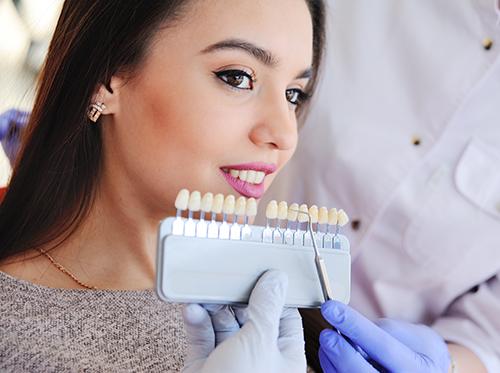
We have noticed that there are two types of patients when it comes to enhancing a person's smile. One type, which we'll call the “Perfect Minded” patient, expects teeth that are completely regular in their arrangement and of maximum whiteness and brightness, often beyond the range of traditional guides for tooth color. They are looking for a perfect “Hollywood” smile. The other, the “Natural Minded” patient, is looking for a more natural look. This person expects a general sense of regularity and alignment of teeth with definite brightness, but not so much that the teeth are noticeable before and above other facial features. Which type are you?

The “Perfect Minded” Patient
While you expect maximum regularity and alignment of teeth along with maximum whiteness and brightness, the “perfect minded” patient requires a smile completely symmetrical (balanced from one side to the other). If we drew a vertical line down the center of your face (midline), it would fall directly between your front teeth and your smile would look just the same on each side of the line. You also expect your smile to be horizontally symmetric, so that it matches the curvature of your lower lip and the gum lines match from side to side.

The “Natural Minded” Patient
You are looking for a more subtle, natural look produced by including some minor irregularities in your look. Like the “Perfect Minded” individual, you still expect your teeth to be generally regular and well aligned but you also want to have some minor asymmetries (not matching) as you move farther back along your jaw to make your teeth look real. Your preference in tooth color is not a super shade of white, but for a tooth color that looks very natural for your facial skin and hair color.

There is no right or wrong here. What is important is to be sure to communicate your expectations to us before embarking on a program of smile redesign.

Contact us today to schedule an appointment to discuss your questions about Smile Design. You can also learn more by reading the Dear Doctor magazine article “Great Expectations — Perceptions in Smile Design.”

By Your Family Dentist, PC
February 16, 2012
Category: Dental Procedures
Tags: oral health   root canal  
QuestionsToAskBeforeGettingRootCanalTreatment

Hearing the news that you need a root canal often causes anxiety for most people given all the bad press this procedure has received (e.g., “I'd rather have a root canal than...”). However, the truth is that root canal treatment relieves pain; it doesn't cause it. And it is typically highly successful. The real pain occurs for most people when decay is left untreated or the nerve in a tooth under a very large filling becomes infected and dies.

For these reasons, we have put together the following list of questions you should consider asking prior to having a root canal or endodontic (“endo” – inside: “dontic” – tooth) treatment.

  • Am I a good candidate for root canal treatment?
  • Does it hurt to have a root canal?
  • What can I expect if I do not have a root canal treatment?
  • Are there any other treatment options for me given my situation? If so, what are they?
  • Do you do root canal treatment or should I see a specialist?
  • How long will the entire process take from my first appointment until my root canal treatment has healed?
  • Will the pain I am in immediately subside after a root canal or will it take some time?
  • Will I need or receive any type of sedation while having the treatment?
  • Are there any risks associated with root canal treatment? If so, what are they?
  • How long can I expect my natural tooth to last after root canal treatment?
  • What could happen to cause a root canal to require a second treatment?
  • How much will my root canal cost?
  • Will my insurance cover all or a portion of the cost?
  • Will the tooth be as strong after root canal treatment, or will it need a crown?
  • Will there be any special maintenance required on an ongoing basis after I have a root canal?

To learn more about root canals, continue reading the Dear Doctor article, “I'd Rather Have A Root Canal.” Or if you feel you may need a root canal or other dental procedure, contact us today to schedule a consultation.


This website includes materials that are protected by copyright, or other proprietary rights. Transmission or reproduction of protected items beyond that allowed by fair use, as defined in the copyright laws, requires the written permission of the copyright owners.

Dr. Yati Yadav, DDS, FAGD
Dr. Yati Yadav, DDS, FAGD is a perfectionist and an artist focusing on all areas of general dentistry, especially smile enhancement and reconstructive dentistry to ensure that your smile lasts a lifetime.

Read more about Your Family Dentist, PC

Questions or Comments?
We encourage you to contact us whenever you have an interest or concern about our services.